Crypto/investment scams #1 riskiest in 2024
Investment scams, including those involving cryptocurrency, remained the riskiest scam type in 2024, according to a new report from the Better Business Bureau. Romance/friendship scams climbed to No. 3 riskiest for the first time since BBB began publishing the report.
Both types of scams involve financial grooming, where the scammer builds a relationship with the victim before perpetrating the scam.
More than 80 percent of people who were targeted by investment/cryptocurrency scams, No. 1 riskiest, reported losing money to BBB Scam Tracker. It also had the second highest median dollar loss at $5,000. Investment scams take many forms, including pressure to purchase, trade, or store digital assets (cryptocurrency) with fraudulent exchanges.
The report includes insights about how scams are perpetrated, who is being targeted, which scams have the greatest impact, and behaviors and factors that may impact an individual’s susceptibility.
Read and download the full report
Click above to access the report. Download and share our highlights sheets below.
For more information about the contents of this report, or to schedule a presentation about its findings, please contact us.
2024 BBB Scam Trackersm Risk Report
The report includes insights about how scams are perpetrated, who is being targeted, which scams have the greatest impact, and behaviors and factors that may impact an individual’s susceptibility.
The data from BBB Scam Tracker reports help us understand how scams are being perpetrated in the marketplace. In 2024, BBB Scam Tracker published more than 81,000 reported scams. We classified scam reports submitted by individuals and businesses across the United States and Canada into 33 scam types and an “other” category that represented 6.9% of all reports.
Data collected from each scam report includes a description of the scam, the dollar value of any loss, and information about the contact and payment methods. Demographic data (age, gender, military status, and postal code) about the person targeted by the scam is optional for businesses and individuals.
Crypto/investment scams #1 riskiest in 2024
Investment scams, including those involving cryptocurrency, remained the riskiest scam type in 2024, according to a new report from the Better Business Bureau. Romance/friendship scams climbed to No. 3 riskiest for the first time since BBB began publishing the report.
Both types of scams involve financial grooming, where the scammer builds a relationship with the victim before perpetrating the scam.
More than 80 percent of people who were targeted by investment/cryptocurrency scams, No. 1 riskiest, reported losing money to BBB Scam Tracker. It also had the second highest median dollar loss at $5,000. Investment scams take many forms, including pressure to purchase, trade, or store digital assets (cryptocurrency) with fraudulent exchanges.
Reported median dollar increases
In 2024, susceptibility (the percentage of people who reported losing money when exposed to a scam) decreased from 52.0% in 2023 to 44.4% in 2024. Reported median dollar loss increased from $100 in 2023 to $130 in 2024.
Changes to list of riskiest scam types
Although the top two riskiest scams remained the same as those reported in 2023, there were some changes further down the list this year. For the first time since we began publishing the report in 2016, online purchase scams did not rank among the top three riskiest scams. Romance/friendship scams rose to No. 3 riskiest.
How scammers engaged their targets
In 2024, the top three contact methods resulting in a reported monetary loss remained the same as in 2023: social media, website, and email. Credit cards remained the top reported payment method, followed by bank account debit and online payment system (digital payment app). Reports with a loss via cryptocurrency rose from 3.0% in 2023 to 4.8% in 2024.
10 Riskiest scams reported by consumers in 2024
Each year, BBB Institute publishes its list of the 10 riskiest scam types, which we calculate using the BBB Risk Index and reports submitted to BBB Scam Tracker. In 2024, investment/cryptocurrency scams remained the No. 1 riskiest scam type, with 80.1% of those targeted reporting a monetary loss. The reported median dollar loss ($5,000) was significantly higher than the median dollar loss for scams overall ($130). Employment scams remained the second riskiest scam with a high median dollar loss ($1,500).
Online purchase scams dropped out of the top three riskiest scams on our list despite being the most reported scam type. Meanwhile, romance/ friendship scams rose on our list from No. 5 to No. 3 because of their very high median dollar loss ($6,099) and more than 64.5% of targeted people reporting a monetary loss. This significant increase may be due to the rise in financial grooming scams).
Scam types with high susceptibility
The scam types with the highest percentage of reports with a dollar loss included online purchase (87.5%), counterfeit product (80.7%), investment/ cryptocurrency (80.1%), and moving (74.1%).
Scam types with high median dollar loss
The scam types with the highest median dollar loss included romance/ friendship ($6,099), investment/cryptocurrency ($5,000), government grant ($1,825), and home improvement ($1,800).
Financial grooming scams lead to high-dollar losses
In 2024, investment/cryptocurrency scams remained the No. 1 riskiest scam on our list while romance/friendship scams climbed to No. 3 riskiest. Both scam types can be forms of financial grooming, during which the scammer builds a relationship with the potential victim before perpetrating the scam.
Financial grooming scams are often complex and devastating for victims. Scammers with the goal of perpetrating an investment scam take weeks or months to build trust with potential victims. Once trust has been built with the victim, the scammer drops hints about their own financial success. Eventually, the scammer encourages the person to try investing, often in cryptocurrency. It always starts small, with the scammer continuing to build trust over time. The person begins to see their initial investment grow, and the scammer encourages them to invest even more money. But then the person realizes too late, once they’ve invested a significant amount, that the platform is fake, and they can’t get their money back.
A newer trend in financial grooming fraud involves employment scams. Scammers hire people and insist on paying them in cryptocurrency. The new hires are told to open a cryptocurrency account, which requires them to deposit money. When it’s time to access their pay, they are required to deposit more funds or pay a fee or taxes.
Phishing scams rise on riskiest scams list
Phishing/social engineering scams rose from the No. 7 riskiest in 2023 to No. 6 riskiest in 2024 because of an increase in exposure and median dollar loss. Social engineering encompasses a wide range of tactics that use psychological manipulation to gain information from a person. Phishing is a type of social engineering that uses digital communications (for example, email or text message) to trick somebody into revealing sensitive information that the scammer will use to gain access to bank accounts or to steal a person’s identity.
Scammers have traditionally used generic templates and information to perpetrate phishing attacks. These attempts are identifiable because they are not usually personalized to the target, and many include typos and grammatical errors. However, with more personal information being stolen from people and scammers’ increased use of artificial intelligence, phishing has become much more sophisticated. Scammers can now personalize their attacks and target many more people at once.
Age
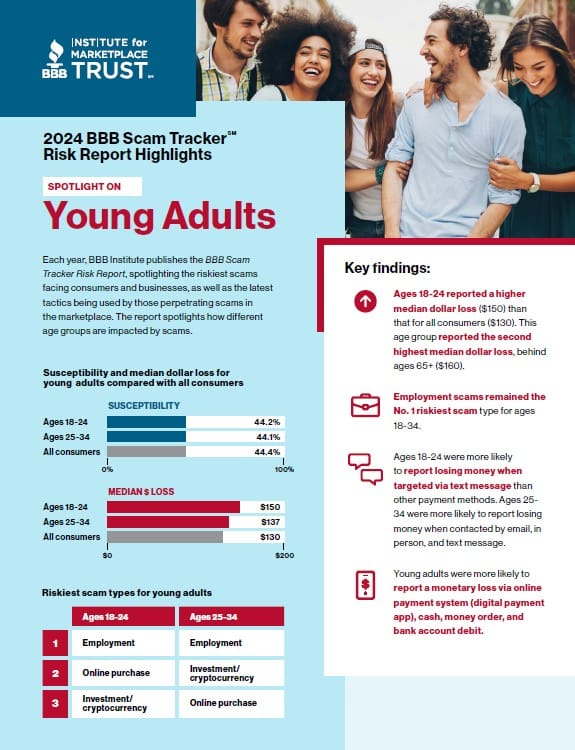
This year, people ages 65+ reported the highest median dollar loss ($160), followed by people ages 18–24 ($150). People ages 35 – 54 submitted a slightly higher percentage of reports with a monetary loss (susceptibility) than other age groups; people 65 and older reported the lowest susceptibility (41.9%). Employment scams were the riskiest scam type for people ages 18–34. Investment/ cryptocurrency scams were riskiest for those 35 or older.
Scams targeting youth
BBB Scam Tracker does not collect information from people younger than age 18. However, we know young people are being targeted. Of the 22.9% of survey respondents who reported having children younger than eighteen, 9.7% said their children were targeted by scams. Respondents reported that their children were targeted via social media, phone call/ text message, gaming platforms, email, and phone app.
Gender
Similar to previous years, more than 60% of reports to BBB Scam Tracker were submitted by females. Females reported being more susceptible to losing money when exposed to a scam (45.5%) compared to males (42.4%) and non-binary people (33.6%). The reported median dollar loss was significantly lower for females ($102) and non-binary people ($120) than for males ($200). Females and males reported the same top three riskiest scam types. The No. 1 riskiest scam type reported by non-binary people was employment scams.
Military consumers
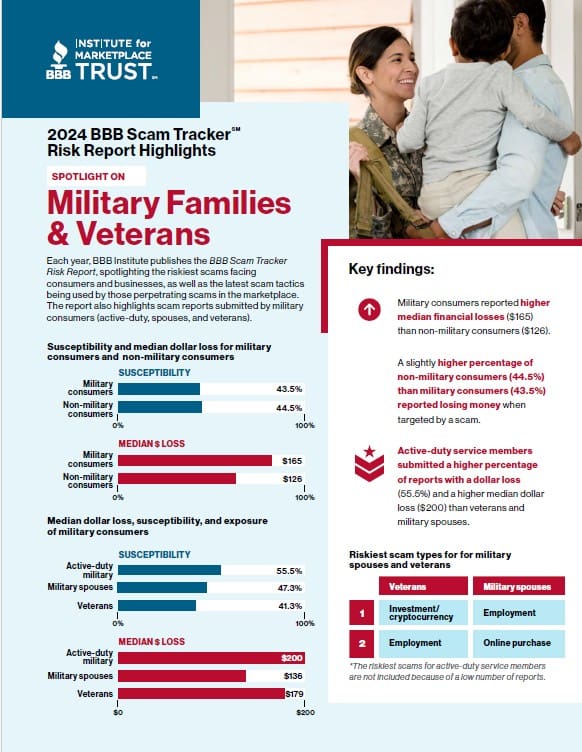
Military consumers who self-identified as being active-duty military personnel, military spouses, or veterans submitted 9.8% of all reports to BBB Scam Tracker in 2024. Military consumers reported higher median financial losses ($165) than non-military consumers ($126). A slightly higher percentage of non-military consumers (44.5%) than military consumers (43.5%) reported losing money when targeted by a scam. As in previous years, we received more reports from veterans than from military spouses and active-duty service members. Service members submitted a higher percentage of reports with a dollar loss (55.5%) and a higher median dollar loss ($200) than veterans and military spouses. The BBB Risk Index was applied to identify the three riskiest scams for military spouses and veterans (Table 6). The No. 1 riskiest scam type for military spouses was employment scams. Investment/cryptocurrency scams were riskiest for veterans.
Scams targeting businesses
BBB Scam Tracker also collects information about scams that target businesses. Businesses reported losing money 29.0% of the time when they were targeted, a significantly lower susceptibility than that reported by consumers (44.4%). However, the overall median dollar loss reported by businesses, about $1,200, was significantly higher than that reported by consumers ($130). The three riskiest business scams based on the BBB Risk Index were online purchase, phishing/social engineering, and fake invoice/supplier bill scams.